The $300,000 Deepfake Call
And Why the AI Economy Needs a Trust Layer
A finance employee joins what appears to be a routine video call with senior leadership.
The request is urgent but believable: Authorize several wire transfers tied to operations in China.
Everyone on the call looks legitimate. The faces match. The voices sound real. The conversation feels authentic.
So the employee complies. Only later does the truth emerge: Every participant on the call - except the victim - was AI-generated.
The result: hundreds of thousands of dollars lost in a sophisticated deepfake scam.
The lesson isn't simply that deepfakes are dangerous.
It's that AI has broken one of the oldest assumptions in digital communication: We can no longer trust that the person on the other side is actually human - or who they claim to be.
The Real Problem Isn't Deepfakes
It's Trust
For decades, organizations relied on implicit trust signals:
- seeing someone on Zoom,
- hearing a familiar voice,
- recognizing a face,
- receiving an email from a known account.
But generative AI has changed the equation.
Today, AI systems can:
- clone voices,
- generate photorealistic avatars,
- simulate live conversations,
- and impersonate people in real time.
The problem is no longer whether something looks real. The problem is whether authenticity itself can be proven.
Because in the AI era:
- seeing is no longer believing,
- hearing is no longer believing,
- and presence alone is no longer proof of identity.
The Missing Layer in AI Infrastructure
The AI industry has spent years building:
- smarter models,
- autonomous agents,
- workflow automation,
- and synthetic media.
But very little infrastructure has been built around trust itself.
Specifically:
- proving human participation,
- authenticating identity,
- verifying accountability,
- and creating immutable records of trusted actions.
That becomes critical in high-stakes workflows like:
- financial approvals,
- legal sign-offs,
- compliance decisions,
- and executive communications.
The question is no longer:
"Can AI do the work?"
The question is:
"Can we prove who was actually involved?" or "Who is accountable?"
Trust Must Become Verifiable
Trust is the foundation of SanctifAI's Human Layer of the AI Economy. It makes human participation verifiable.
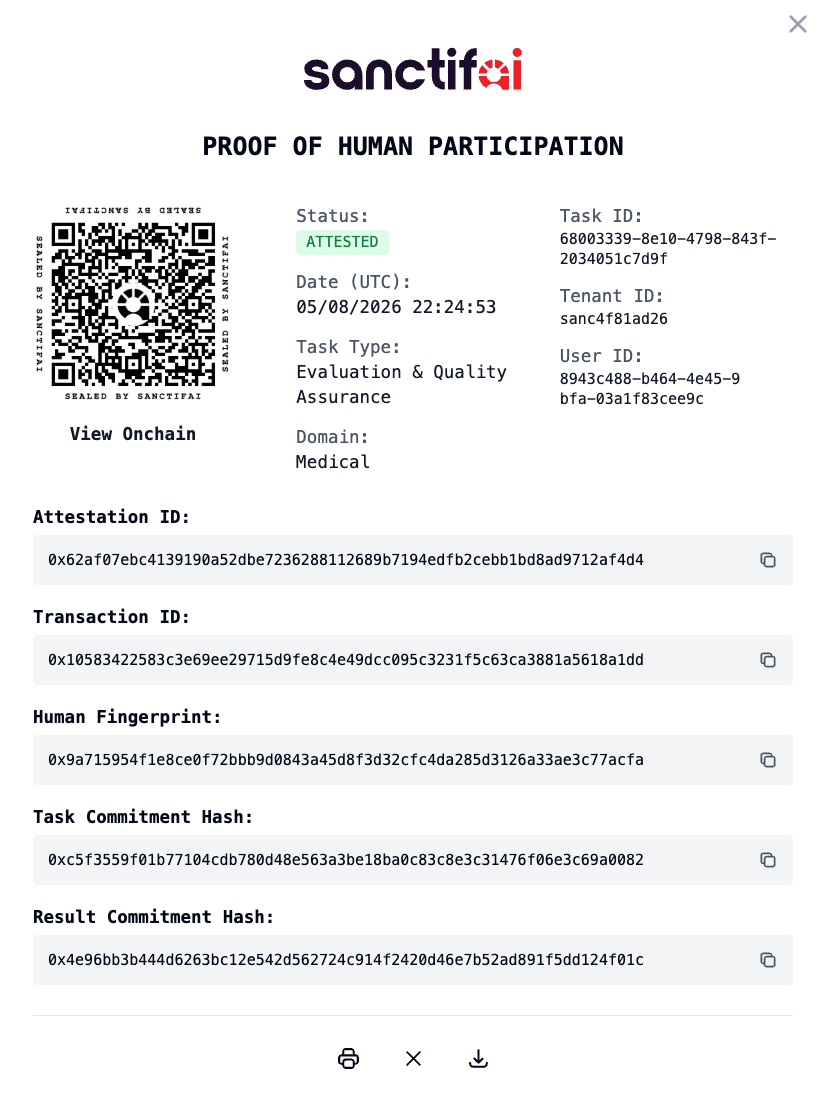
It records every act of human participation as a cryptographic attestation on the blockchain, creating immutable proof that a real person was present during critical moments in an AI workflow.
Instead of relying on assumptions or visual trust signals, SanctifAI creates verifiable proof of human participation and identity.
How Trust Works
1. A High-Risk Request Begins
An AI system initiates a sensitive action:
- approving a wire transfer,
- authorizing a payment,
- signing off on compliance,
- or validating a critical decision.
SanctifAI creates a secure digital challenge tied to that workflow so the action can be verified without exposing private data.
2. A Real Human Confirms Identity
Before the action proceeds, the human participant verifies themselves using:
- Face ID,
- fingerprint authentication,
- or a hardware security key.
This confirms that:
- a real human is present,
- the participant is authenticated,
- and the action is tied to a verified identity - not a bot, spoofed account, or AI impersonation.
In the case of the deepfake wire fraud, this is the difference between:
"This looks like the CFO."
and:
"This approval was cryptographically verified by the CFO."
3. The Action Becomes Immutable
Once the task is completed, SanctifAI generates a tamper-proof attestation recording:
- who acted,
- when they acted,
- and what workflow they participated in.
That proof can remain private or be anchored to a public blockchain for long-term verification and auditability.
Trust becomes permanent, verifiable infrastructure - not assumption.
4. Anyone Can Verify
Every completed workflow can include a "Sealed by SanctifAI" verification layer.
Customers, partners, auditors, or regulators can instantly verify that:
- a real human participated,
- the identity was authenticated,
- and the workflow was completed through a trusted process.
Without exposing personal data. Only the cryptographic proof is shared.
Why This Matters
As AI systems become more autonomous, organizations will increasingly need proof of:
- human authenticity,
- verified identity,
- accountable approvals,
- and trusted participation.
Because soon:
- meetings can be synthetic,
- voices can be cloned,
- approvals can be fabricated,
- and entire conversations can be AI-generated.
The stronger long-term solution is not:
"Can we detect fake humans?"
It is:
"Can we cryptographically verify real ones?"
That is the role of Trust.
Because in a world where AI can imitate almost anyone, the ability to prove a real human was truly there may become one of the most valuable signals in the digital economy.
Make human participation verifiable with SanctifAI Trust
Learn about Trust →About the Author

Beverly Woon
Business Development Manager at SanctifAI, the company building the human layer of the AI economy. SanctifAI provides the infrastructure to Source, Connect, and Prove human participation within agentic systems, ensuring that Human Intelligence remains an inseparable component of the post-AI workforce.